Switch between normal conditions, a major storm, an extended outage and recovery. Every operational value below is fictional demonstration data.
Demo modeFictional examples for understanding the interface.
Live mode readyThe data adapter can later use public-safe NOC endpoints.
No silent fallbackUnavailable live information will never be disguised as current.
One site has moved to backup power while another has incomplete reachability evidence.
Demonstration dashboard
Operational values and incidents shown below are fictional examples.
MeshCore network operations
Major storm
Demo data · Updated 14:32
Demo site
Demo Ridge Repeater
Demo data
Grid power lost · Site online on backup
Mains
Off
Battery
78%
Runtime
8h 35m
Demo site
Demo Valley Hub
Demo data
Normal
Mains
On
Battery
99%
Runtime
21h 40m
Demo site
Demo Community Gateway
Demo data
Degraded
Mains
On
Battery
91%
Runtime
18h 30m
Weather intelligence
Severe storm warning example
Example
Southeast Coast demonstration area
Damaging winds and heavy rainfall. Not a current BOM warning.
MeshCore community feed
Latest radio messages
Demo
ROAD
Tomewin Rd closed — fallen tree. Avoid area.
NETWORK
Community gateway degraded. Monitoring.
POWER
Ridge repeater online on backup battery. 78%.
WEATHER
Example severe storm warning for local area.
Inside the local NOC
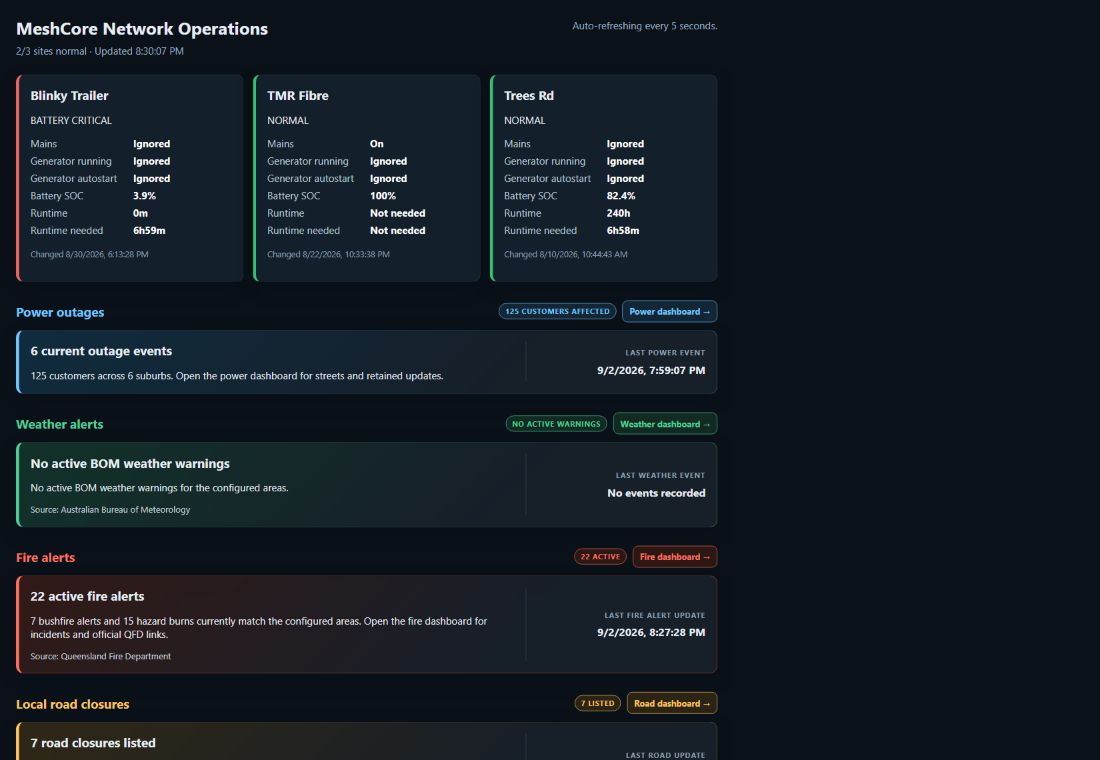
A real view of the dashboard running in Currumbin.
This local dashboard brings tower condition, mains power, battery state and estimated runtime together with public-safe power, weather, fire and road information. It is designed to remain available on the local network during an internet outage.
Local operations dashboard snapshot captured 2 September 2026. This is a point-in-time example, not live status. Select the image to open the shareable full-size version.
Public by design
Useful status without exposing the network.
The public dashboard is read-only. It does not publish entity IDs, monitor names, channels, alert thresholds, credentials, internal URLs, exact radio locations or operational topology.